
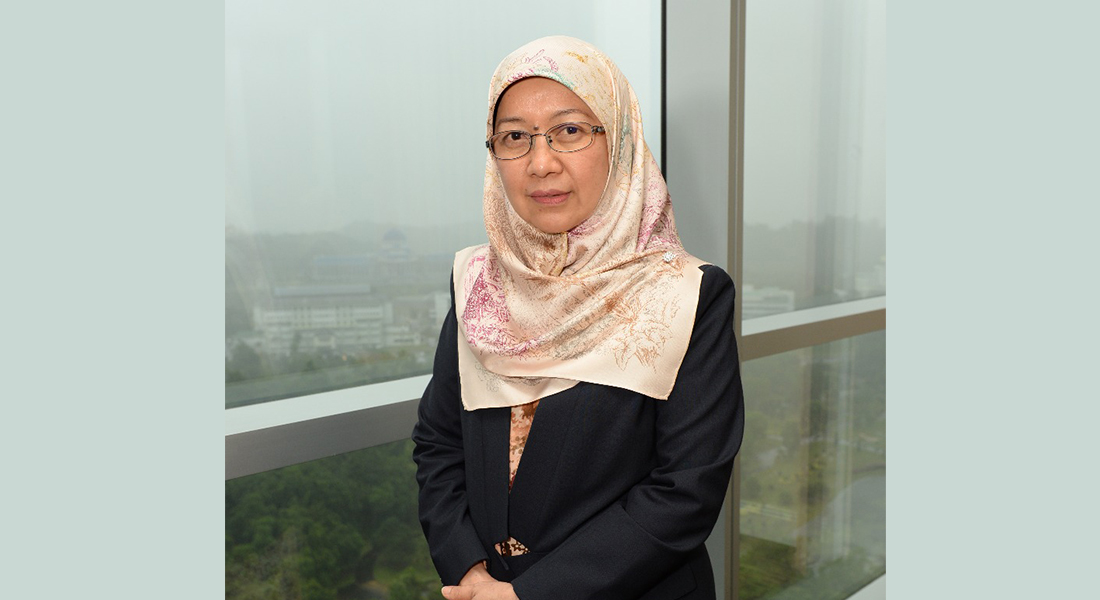
12 Dec Interview with Hajah Rokiah Badar, CEO, Brunei Darussalam Central Bank
What factors have contributed to the recent growth in Brunei’s banking sector?
Brunei’s financial services sector benefits from a strong regulatory framework, high liquidity and solid capital buffers, with banks maintaining capital adequacy ratios above 20%. As of Q3 2024, liquid assets made up 43% of total assets. Brunei’s dual banking system, which combines conventional and Islamic finance, caters to diverse needs and strengthens its position as an Islamic finance hub. Recent growth is attributed to enhanced regulatory oversight, including the Domestic Systemically Important Bank (D-SIB) framework introduced in 2020. The rise of digital payments and platforms such as the Brunei Digital Payment Hub led by the National Digital Payments Network or ndpx has modernized operations. Household lending, particularly for housing and vehicles, has contributed to credit expansion. Brunei’s proactive risk management and interim measures have helped reduce non-performing loans, highlighting the effectiveness of the Central Bank’s strategies. Ongoing enhancements to prudential standards, including Basel III-compliant liquidity measures, further reinforce financial stability and support sector growth.
Brunei faces some specific challenges, including the nation’s reliance on the oil and gas sector, which limits economic diversification and opportunities for banks to explore new sectors or offer innovative products. Brunei’s small domestic market also constrains the growth potential of its financial services players. Furthermore, with 54.5% of banking assets placed offshore, the sector faces risks from global financial market volatility, which complicates monitoring and oversight. Despite these challenges, Brunei’s banking sector remains resilient, supported by its strong foundation, proactive regulations and alignment Brunei’s Vision 2035 strategy. The sector is well-equipped to adapt to evolving macroeconomic conditions while continuing to play a pivotal role in the nation’s economic transformation.
What major milestones has Brunei Darussalam Central Bank (BDCB) recently achieved?
BDCB has adopted a robust legal and regulatory framework to safeguard financial stability, benchmarked against international standards. BDCB sets stringent requirements for financial institutions and monitors them to ensure compliance. To date, BDCB has issued a number of notices and guidelines relating to governance, risk management and consumer protection. We are pleased to have fully implemented the Basel II framework in 2019. These frameworks have strengthened the governance and operational resilience of our financial institutions, which was particularly important during the COVID-19 pandemic.
We have collaborated with the financial sector under the 2016-2025 Financial Sector Blueprint, which includes initiatives like fintech development, the digital payment roadmap and capital market growth. We are also working with the government on establishing an exchange, which is expected soon. In 2017, we marked the 50th anniversary of the Currency Interchangeability Agreement (CIA) with Singapore. The CIA has contributed to macroeconomic stability and low and stable inflation. We look forward to celebrating the CIA’s 60th anniversary in 2027. In 2020, BDCB introduced the BDCB Islamic Bills to enhance short-term liquidity management and support the development of the domestic money market.
How have global partnerships shaped BDCB’s policies and operations?
BDCB signed the memorandum of understanding for regional payment connectivity as the seventh signatory alongside Indonesia, Malaysia, Philippines, Singapore, Thailand and Vietnam.
With its signing, BDCB commits to accelerating the development of payment connectivity, particularly through QR code-based payment and fast payment modalities. In Brunei’s case, this involves the planned implementation of a fast payment system, which is anticipated in the near term. Once stable, opportunities for bilateral connections with countries in the Association of Southeast Asian Nations (ASEAN) region may be explored, starting with neighboring countries frequently visited by Bruneians. We are currently focused on capacity building and learning from our ASEAN counterparts. We have discussed QR code standards with several governors and explored regulatory requirements while ensuring security. We aim to use this opportunity to adopt the latest technologies and learn from others’ experiences.
What key steps has BDCB taken under its digitization strategy?
We launched our fintech regulatory sandbox in 2017, which allows startups to test their products in a controlled environment with limited scope and participation. Based on this, we have updated our legislation to enable the licensing of companies graduating from the sandbox. Thus far, one remittance company has been granted a license after completing its testing in the sandbox. They provide digital remittance at lower fees and have created local jobs. In 2023, we joined the Global Financial Innovation Network, a global fintech association, to learn from our international peers. We also launched the Mekar FinTech Innovation Centre as part of our financial sector blueprint and BDCB strategic plan. The center fosters collaboration among fintech stakeholders and provides a co-working space and platform for regulatory discussions. We aim to attract more startups and invite international fintech companies to share their experiences.
Brunei’s digital payment landscape is also undergoing a major transformation. The recent entry of five new non-bank payment service providers has diversified the market and expanded payment options for both consumers and businesses. This dynamic shift is further supported by the development of a digital payment hub led by the ndpx that aims to enhance interoperability among payment systems and enable seamless and near-instant transactions. This digital revolution will not only facilitate cheaper, more secure and faster payments but also empower businesses to thrive through the stimulation of e-commerce. With the eventual establishment of cross-border linkages, Brunei will further propel its economic growth by leveraging regional and global opportunities.
How has the rise in green investment shaped BDCB’s approach to developing the financial services sector?
BDCB has adopted the ASEAN Sustainability-Linked Bond Standards to promote sustainable finance and mobilize capital for sustainable projects in Brunei and the region. This will allow issuers to attract international investors while also supporting ASEAN’s sustainable development goals. We are working on a sustainable finance roadmap, which has been shared with the government and financial sector and will likely be published in 2025. While our banks are open to it, demand for sustainable finance in Brunei remains minimal, indicating a need for greater awareness and investment in this area.
What initiatives are banks undertaking to attract and develop highly skilled professionals to address knowledge gaps?
Graduating from university is not enough for the financial sector; experience and exposure are key. The Brunei Institute of Leadership & Islamic Finance is a training center for the financial industry under the purview of the BDCB. It provides opportunities for human capacity development in Islamic banking, finance and management. BDCB works closely with banks and insurance companies on professional requirements and continuous learning. Furthermore, the Continuing Professional Development requirement was recently fully enforced. It requires professionals to complete annual training and capacity-building programs. A licensing examination requirement also requires professionals to pass licensing examinations to practice and stay up-to-date on skills, regulations and compliance to conduct regulated activities under the law. In May 2024, the Central Bank issued the Financial Sector Manpower Survey Data Reporting Guidelines for the banking, takaful and insurance, and capital market sectors. The survey is an annual initiative that collects and analyzes data on the financial services workforce. Its main objective is to assess the demand for manpower, identify emerging employment trends and pinpoint potential gaps in skills and qualifications. We use these data sets to implement and enhance training programs and recruitment strategies in the financial services sector to ensure the workforce is ready for current and future challenges.
What are your top personal priorities as Managing Director of BDCB as we enter 2025?
With the ever-changing financial landscape, we know there will be challenges and risks ahead. While some of these are familiar to us, we must keep an eye on emerging trends such as climate and environmental issues, digital currencies and shifting consumer preferences, all of which may bring both risks and opportunities. My main focus is for BDCB to fulfill its mandates, which are to maintain domestic price stability, ensure a strong and stable financial system, oversee efficient payment systems and develop the financial sector. To do this effectively, we must continuously improve by strengthening our governance, enhancing our team’s skills and expertise, improving processes and upgrading our infrastructure. BDCB will continue to strengthen regulations and supervision in alignment with global standards to ensure the sector remains strong and resilient. We will continue to support the sector’s growth in line with the Financial Sector Blueprint, our mandates and Brunei Darussalam’s Wawasan 2035 strategy to drive the nation’s economic progress.
Although Brunei has a small market, it offers diverse opportunities for partnerships and strategic alliances with strong economic, social, environmental and technological value. From the central bank’s perspective, the financial sector is stable. It is supported by a strong legal environment, making it a highly suitable place for long-term investments. We encourage more foreign direct investment to support Brunei’s diversification efforts, particularly in financial sector development and contributions to the country’s economic growth.
Sorry, the comment form is closed at this time.