
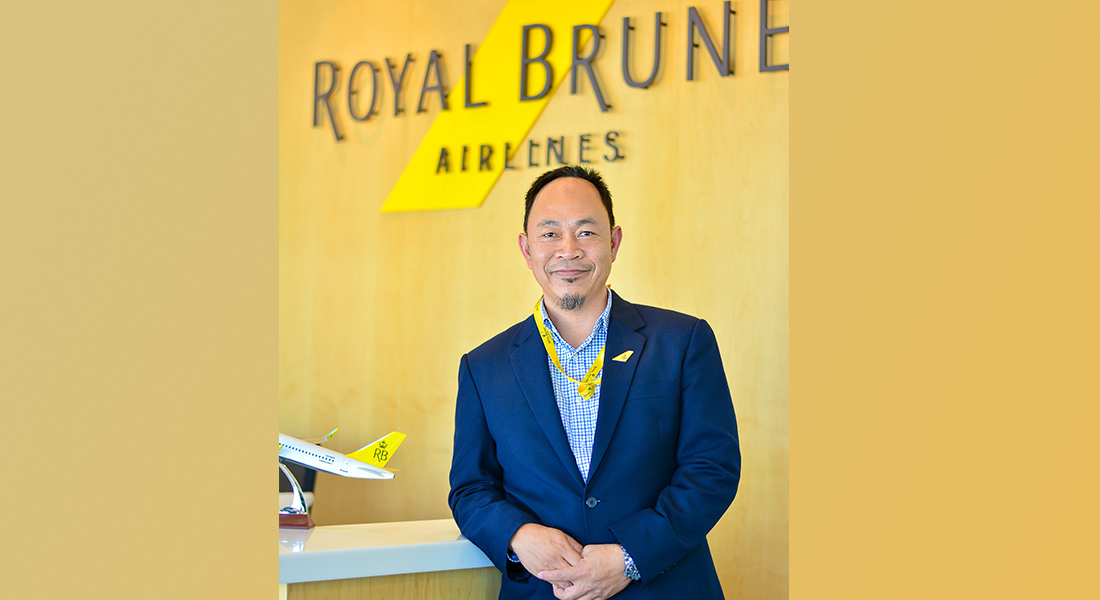
06 Dec Interview with Sabirin Abdul Hamid, CEO, Royal Brunei Airlines
How has your journey from pilot to CEO impacted your leadership strategies in reshaping Royal Brunei Airlines (RB)?
I began my journey with Royal Brunei Airlines in 1988 as a cadet pilot. The training took me to Scotland where I received my commercial pilot license and then to Stansted, London, where I underwent a secondment for two years with AirUK. Upon returning to Brunei, I operated in the RB network flying the Boeing 767 and B757. It was a transformative experience as the airline expanded to destinations beyond the region, including Europe and Australia. In the past, we connected to not only London but Zurich, Frankfurt, Bahrain and Cairo. Over the years, Royal Brunei Airlines has helped showcase Brunei’s identity and attract global travelers. I returned in 2021 as COO following a four-year break, previously serving as vice president of quality, safety, security and environment. In 2022, I stepped up as CEO and was tasked with steering the airline’s post-pandemic recovery and growth. My background as a pilot has been invaluable; it has taught me the importance of efficiency, safety and teamwork. Today, my main focus is on evolving Royal Brunei Airlines into a stronger, more agile company and preparing it for challenges ahead. As COO and later CEO, I have focused on enhancing our services and building on the strong foundation we established before the pandemic, including various awards for our cabin crew and service quality.
RB has seen its share of ups and downs. During COVID-19, operations came to a standstill, allowing us to reassess our strengths and weaknesses and refine our strategy. We maintained momentum by continuing training and refining our service DNA. This led to the development of our “Ikhlas from the Heart” concept — service delivered with sincerity and genuine care from the heart. We aimed to create a more personalized experience while maintaining high standards, focusing on authenticity and thoughtful delivery. Despite the challenges of the pandemic, this approach has significantly strengthened our level of service and elevated our onboard experience.
How has the COVID-19 pandemic reshaped the airline’s operations?
Before the pandemic, network growth was our main focus. However, during the crisis, we re-evaluated our priorities. As a commercial entity, Royal Brunei Airlines must balance profitability with strategic growth. Previously, aggressive expansion did not yield strong commercial performance. In the post-COVID era, we are focusing on measured and commercially viable growth. Rather than trying to fly everywhere, we have strategically selected destinations that enhance connectivity. For example, flights to Singapore, Kuala Lumpur, Hong Kong and Tokyo allow passengers to connect globally while maintaining strong links to Brunei. This ensures every flight contributes to our commercial success while catering to a small domestic market and leveraging the region’s population of 600 million. With a smaller fleet compared to regional airlines, we use our resources strategically to maintain a broad network and attract passengers to fly with us. Our enhanced services and improved products highlight who we are and what we offer. Though small, Royal Brunei aims to deliver a mighty experience.
What impact will the recent order of new aircraft have on RB?
By 2028, our current Boeing 787s will be 15 years old. While still relatively young, they will incur higher maintenance and operational costs. Replacing them with new aircraft is more cost-effective and allows us to refresh our product. Our current fleet, delivered in 2013 and 2018, still meets our standards but reflects an older design. In 2024, we placed an order for four Boeing 787-9s. These new aircraft will offer enhanced products, including 30 business class seats, 32 premium economy and 212 economy seating. They will diversify both our offerings and revenue streams. Despite a slight reduction in our fleet size, the increased revenue potential makes this transition a strategic move.
How has RB updated its services to meet the rapidly evolving needs of travelers and continue winning awards?
Over the past five years, passenger behavior has shifted significantly. Travelers now demand seamless processes, fewer queues and more technological solutions at every stage, from check-in to baggage handling. To address this, we have introduced innovations such as a mobile app for booking and check-in to make travel with us more convenient and efficient. One of our key initiatives is RB SkySavour, which allows passengers to pre-order meals before their flight. This enhances personalization and reduces food waste. By aligning with global sustainability goals, we have minimized over-catering while saving costs and benefiting the environment. This initiative exemplifies our broader focus on improving efficiency and delivering a better travel experience while being mindful of our environmental impact — a win for both passengers and the planet.
How critical is reducing aviation’s carbon footprint and what specific measures is RB implementing to meet global environmental goals?
At the 2024 United Nations Climate Change Conference in Baku, the focus remained on decarbonizing aviation and reducing carbon emissions annually. The aviation industry, led by the International Civil Aviation Organization and International Air Transport Association, has committed to achieving net zero carbon emissions by 2050. RB is working tirelessly to meet these targets. We host workshops in Brunei to raise awareness among local fuel suppliers, government bodies and regulators of the importance of making sustainable aviation fuel (SAF) available. This is a significant challenge for Brunei, as we lack large-scale biomass sources for SAF production and must explore alternative technologies. As a fossil fuel-dependent nation, this shift requires a dramatic change in mindset. By collaborating with the International Air Transport Association and conducting these workshops, we aim to brainstorm solutions and drive progress toward a more sustainable future for aviation. The government has established climate change bodies to reduce emissions. Brunei still maintains around 70% forest cover.
As part of the Association of Asia Pacific Airlines, we have committed to using 5% SAF by 2030, which will increase to 10% in the following decade with the final goal to achieve net-zero emissions by 2050. The global SAF supply remains a challenge as demand grows, and the use of SAF alone will only reduce emissions by 65%. The rest must come from operational efficiency, regulatory measures and technological improvements. We optimize flight paths for the most direct routes. However, long-haul flights — especially over conflict zones — add complexity. Every flight undergoes a risk assessment to minimize unnecessary fuel consumption and emissions. In Brunei, workshops emphasize that sustainability is not just a national or corporate issue but a global responsibility for future generations. As a company, we adopt energy-saving practices such as minimizing unnecessary electricity use. These initiatives reflect our commitment to sustainability at every level.
What milestones has RB achieved under its current digitization strategy?
Technology and digitalization play a vital role in transforming our operations and passenger experience. While we have made progress, such as online check-ins via our app, there is still work to be done at the airport. We do not manage the airport and must collaborate with stakeholders to ensure technology is seamlessly integrated from mobile devices to airport services. Internally, we are leveraging data and artificial intelligence to enhance decision-making. For example, we analyze travel trends, destination traffic volumes and agent sales to refine our offerings. These tools help us design better services, adapt to industry advancements and ensure
Royal Brunei remains at the forefront of innovation. For example, my business card is now a QR code on my phone, a solution designed by our information technology team. Similarly, our SkyBreathe system tracks carbon emissions and fuel efficiency for every flight and provides detailed data on fuel consumption, carbon reduction and savings. Technology plays a crucial role in ensuring the airline’s environmental sustainability and overall efficiency. Our digital solutions have also transformed how we work. Tasks previously done manually are now handled more efficiently through software and apps. Rather than reducing manpower, we have redeployed staff to more strategic and engaging roles. While we had to downsize during the pandemic like many others, we have since focused on retaining and reskilling our workforce, preparing for a more innovative and efficient future.
What efforts is RB making to support the government’s tourism agenda?
We aim to connect Brunei to the world through improved network design while promoting Brunei as a niche tourist destination with unique offerings. Last month, we launched a new destination to Chennai, India in collaboration with the Brunei Economic Development Board to showcase Brunei’s business environment, investment opportunities and tourism potential. We also partnered with Brunei Tourism to provide a platform to promote Brunei to the Indian community. Our new route to Chennai taps into the growing Indian market, with its population of 1.4 billion and expanding middle class eager to travel. By offering direct flights, we aim to attract Indian tourists to Brunei while serving the Indian community in Brunei who previously relied on connections via Singapore or Kuala Lumpur. These strategic routes reflect our commitment to connecting Brunei to key regional markets and showcasing its unique offerings. Our efforts focus on positioning Brunei as a vibrant destination and fostering connections globally
What strategic destinations is RB considering in 2025 to increase the nation’s global connectivity?
Balikpapan, a city in Indonesia’s Kalimantan region on Borneo island, is strategically important. Indonesia plans to move its administrative capital to Kota Nusantara, which is located just north of the larger Balikpapan municipality. Although the capital relocation has begun, with Indonesia’s National Day recently celebrated there, our connection to Balikpapan will resume in February 2025. Balikpapan, once part of our network in the 1990s, will play a significant role in boosting connectivity and tourism for both Brunei and Indonesia. This route links Brunei with the new capital and will foster business and tourism opportunities. The route is strategically scheduled to connect passengers from key markets like China and Korea and enable seamless transfers through Brunei. Not only does it promote tourism but also strengthens business ties with the region.
Why should US citizens consider Brunei as their next travel destination?
Brunei is a hidden gem in the region that offers unique experiences. Through Royal Brunei Airlines, we connect Brunei to the world and invite everyone to experience Brunei’s serene beauty, untouched nature and peaceful ambiance. The nation is a true escape from the bustling city life of places like Singapore and New York. Brunei is not about mass tourism or entertainment; it’s about quiet moments in nature and a tranquil getaway. Come and see for yourself. Fly with Royal Brunei Airlines and discover a vacation where relaxation meets natural beauty. We hope you will be pleasantly surprised.
Sorry, the comment form is closed at this time.